
C Change, North West
C Change Intro
C Change is the North West’s Creativity Collaborative with a mission to harness the power of creativity to transform the educational experience of young people and their communities. We believe that creativity, community and culture are key to making a change in the lives of young people.
Led by St Bernard’s Primary and Nursery School in Ellesmere Port, we are a network of schools testing a range of innovative practices in teaching for creativity. Our schools came from a range of settings including early years, primary, secondary, specialists and alternative provision.
We collaborative with a network of local, regional, and national partners to drive systemic change to ensure all young people have the opportunity to thrive. Community and place-based partnerships are at the heart of what we do.
Pilot and Legacy phase
-
Pilot phase
During the pilot phase of the Creativity Collaboratives programme, C Change conducted research on the following lines of inquiry:
How do creative pedagogies contribute to the experience of education for young people from disadvantaged backgrounds?
What are the conditions needed to foster a culture of curiosity and creativity within and across schools?
What pedagogies effectively cultivate creative thinking across the curriculum and in particular for disadvantaged pupils?
What strategies support effective cultural and creative partnerships for schools, communities and young people?
Using the school as a learning organisation model, we were able to measure the impact on pupils, teachers, leaders, schools and communities.
Impact on pupils
An increase in agency
Increased confidence and resilience
Increased pride and self esteem
Improved metacognition
Better communication and collaboration skills
Impact on teachers
Greater agency
Investing more time in research
Deeper understanding of how pedagogies can impact pupils
Improved skills and confidence
Valuing professional development and lifelong learning
Impact on leaders
Creativity integral to vision and strategy
Development of culture and ethos that embraces creativity
Redesigning curriculum
Greater commitment to creativity in professional development
Impact on the wider system
Widening educational opportunities through creative partnerships
Revitalisation of culture
Creativity in the service of regeneration
Creativity in the service of employment
From our three years of research we have learnt that:
1. Schools need strong leadership to facilitate the development and implementation of creative approaches.
2. Creativity needs to be core to the schools’ vision and purpose.
3. For creativity to flourish people need dedicated time and space.
4. Establishing a shared language around creativity is key.
5. Knowledge and creative habits drive powerful learning.
6. Advocates for creativity are needed at all levels.
7. Professional learning networks are principle drivers for change.
8. Inquiry is a powerful tool for increasing teacher agency when exploring creative pedagogies.
9. There needs to be an explicit mechanism for sharing learning.
10. Links between creativity in schools and wider industry/community contexts are crucial.
11. Partnerships with creativity and culture at the core invigorate communities and encourage change.
12. Creativity and creative thinking frameworks are recognised as valuable skills for employers.
-
Legacy phase
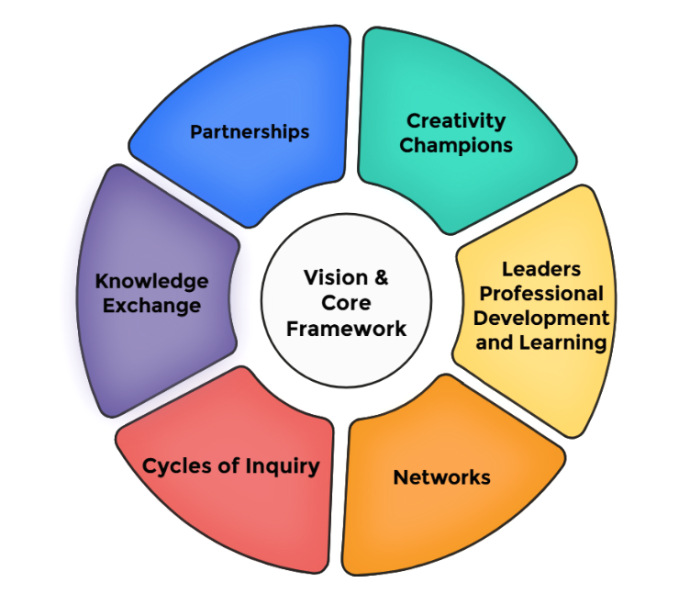
As C Change moves into the legacy phase, we are building on what we have learnt from the pilot phase. Our schools are continuing to embed creativity across their whole curriculum. It remains a core focus and Creativity Champions in all our schools continue to support their staff in developing signature pedagogies that allow young people to develop their creative thinking skills.
Our four main areas of focus are:
Creative capacities of students and teachers
Enjoyment and engagement
Inclusion
Student agency
C Change continues to work with wider partners and connect schools with their communities. This enables them to enhance their school curriculum and provide real life experiences which allow the development of students’ creative capacities.
In our two secondary schools our Learning Ambassador teams continue to be key drivers in the work around creative thinking in curriculum and assessment. We are providing opportunities for them to develop their agency and help shape decisions around the educational experiences of themselves and their peers.
The ambassadors are working on bespoke digital portfolios to document and celebrate how they are developing their creative skills.
In autumn 2025, five of the C Change schools will begin a ‘Changemakers’ project in partnership with Chester Zoo which will bring together creative thinking and sustainability. Using the model of Schools Citizen Assemblies and the design thinking process, students will be designing and creating sustainable solutions to solve issues in their own school communities.
Sharing good practice beyond our collaborative remains a focus. Working alongside Creativity, Culture and Education (CCE), we are creating a new network across the Liverpool City Region to better connect employers and schools through the lens of creativity.
C Change has delivered creative thinking training for other school trusts and national networks. We have connected with a cultural and creative network in Hong Kong.