
University of Winchester Academy Trust
Introduction to the University of Winchester Academy Trust Creativity Collaborative
The University of Winchester Academy Trust Creativity Collaborative is formed from a range of schools located in and around the Hampshire area, working in partnership with the University of Winchester to develop and embed teaching for creativity.
In our school classroom context, creativity means the process through which novel, effective, and personally meaningful outcomes are produced in response to a problem or topic that may be in any area of the school curriculum.
Our collaborative encompasses schools from a wide range of contexts, with differences in size, and organisational structures.
Summary of our values, beliefs and approach
The starting point for our collaborative was a desire to enrich children’s life chances through supporting them to become confident and creative problem-solvers, engaging them through authentic, meaningful problems, embedded in their schools and lives. We passionately believe that creativity is a force that enables our learners to develop capabilities that will facilitate them to build successful and rewarding lives, as members of communities in an ever-changing world. We further believe that creativity is important for all children across the whole school curriculum and that creative thinking and traditional academic outcomes are intertwined, and mutually reinforcing, with both contributing to success as a learner.
A driving principle underpinning the activities of our collaborative is that change needs to be systemic and multi-level. Consequently, our collaborative has worked with pre-service teachers, qualified teachers, headteachers and school leaders, governors and, of course, pupils. Further, we have systematically gathered evidence on the impact of our approaches using a range of research tools. These have included questionnaires, interviews, focus groups and teacher assessments. We have found that using a co-developed framework of teaching for creativity – the Creativity Navigator – has successfully supported our schools to teach for creativity with benefits for teachers’ practice and pupils’ learning, engagement, creativity and wellbeing at school.
Links to University of Winchester Academy Trust resources
Creativity Collaboratives Pilot and Legacy phase
-
Pilot phase
Making systemic, sustainable change to support teaching for creativity
Recognising that change needs to be systemic and multi-level, our collaborative focused on five interleaved foci of activity. These were context, leadership, knowledge, agency, and pedagogies for creativity in schools.
Context for creativity identified barriers and enablers of teaching for creativity in our schools to ensure that we could address them in our context.
Work with school leaders aimed to support effective leadership, governance, and collaboration strategies to grow a climate for creativity and make sustainable change.
Knowledge for creativity developed pupils’, teachers’, and leaders’ understanding of creativity and how creative thinking can be fostered.
In terms of agency for creativity, our work built on research evidence that if teachers and pupils perceive themselves to be creative, they are more likely to invest in creative activities, and that these creative self-beliefs are supported by an understanding of how creativity can be taught and learned.
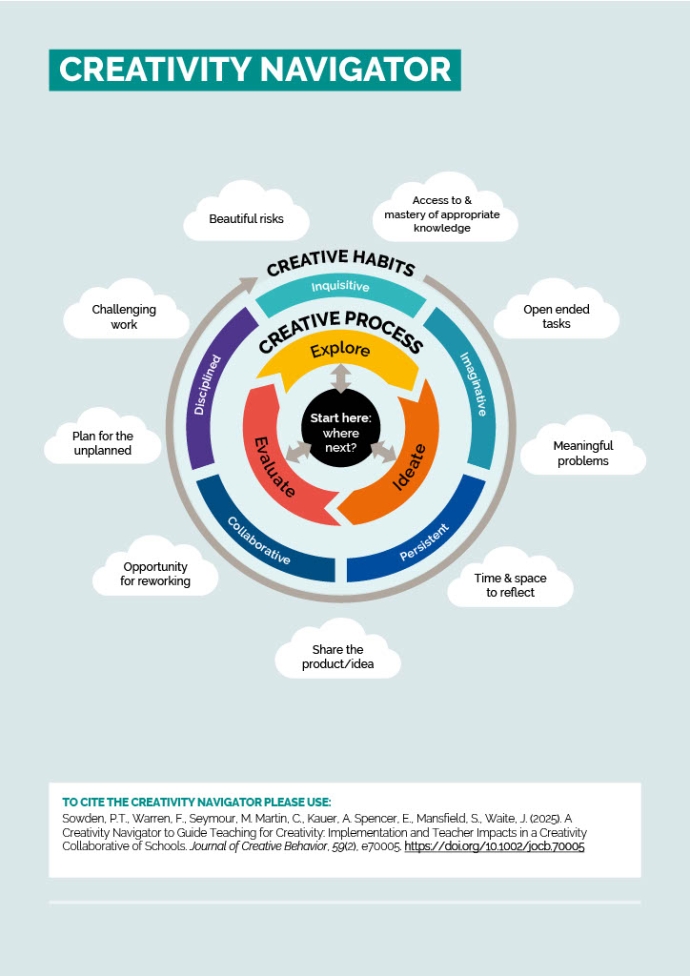
Our work on pedagogies for creativity supported teachers to develop and trial new approaches to teaching for creativity, underpinned by our co-developed framework – the Creativity Navigator.
The Creativity Navigator: a framework for planning teaching for creativity
The Creativity Navigator prompts teachers to consider how creative learning behaviours can support each element of a creative thinking process that focuses on three distinct phases – explore, ideate, and evaluate.
The explore phase is focused on gathering information related to a topic or problem. It can involve: searching for and retrieving relevant information or past experiences; building new knowledge and skills required to produce meaningful work on the problem; exploring different perspectives on the topic; defining success criteria; and constructing the problem in multiple ways.
The ideate phase is focused on using all the learning from the explore phase to support the generation of novel ideas about how to approach and produce a response to a topic or problem. This can involve making new connections to produce potential solutions that may meet the success criteria. Ideation may involve the production of prototypes or drafts that represent the ideas generated.
The evaluate phase then assesses the creative ideas and outcomes to determine how effectively they address the topic or problem. This can involve evaluating responses against success criteria to choose the best option, identifying potential areas for improvement, or outlining steps for implementation.
Creative learning behaviours, such as the five habits proposed by Lucas, Claxton and Spencer (2013), can support each of the phases of the creative process. For instance, collaboration could be used to explore other perspectives on a problem through a think-pair-share routine and later to evaluate ideas through peer feedback.
The final aspect of our Creativity Navigator focuses on the types of classroom climate and task design that can support creative outcomes. This could be tasks that are personally meaningful, challenging, and open-ended, with children having some autonomy over aspect(s) of their learning. The climate needs to provide psychological safety for children to take risks, make mistakes, and learn from them and rework.
Impacts of teaching for creativity
Using sources of evidence including interviews and focus groups with pupils, teachers and leaders, questionnaires, observations and videos of classroom activity, we found a range of beneficial impacts of teaching for creativity.
Pupil impacts
We found that pupils demonstrated more autonomy in their learning, with creative units of work being more empowering for all children, and especially those with SEND. The greater engagement, inclusion of, and equity for all pupils has been one of the most frequent observations from teachers in our collaborative about the benefits of teaching for creativity. Other significant benefits observed were: increased creativity of pupils’ work; greater depth of learning and conceptual understanding; positive impacts on pupils’ learning strategies, processes and dispositions, including working with others; and the development of key transferable skills, including resilience, critical thinking, and problem solving.
Teacher impacts
We found evidence that teaching for creativity using the Creativity Navigator framework and aligned pedagogies significantly increased teacher knowledge of creativity, their belief that creativity can be learned, their confidence to teach for creativity, their self-efficacy for teaching more generally, and their sense of themselves as creative. All of these outcomes were reflected in teachers showing an increased sense of agency about teaching for creativity.
Leader and school impacts
The work of our collaborative had the most sustained effect in schools where its aims were closely aligned with the school leaders’ own strategic vision for curriculum development and the enrichment of pupils’ learning experiences. Leadership has been identified as a critical enabler of whole-school change, where head teachers actively seek to integrate creativity into school improvement priorities while also demonstrating visible and sustained advocacy for the approach. We have found that cultivating a culture that supports creative thinking and creativity requires school leaders to model professional risk taking, celebrate incremental progress, and engage in open, collaborative dialogue with staff. Our findings suggest that the successful embedding of creative pedagogy is contingent not only on strategic planning, but also on the active and ongoing involvement of school leaders in shaping and supporting the conditions for creative practice to flourish.
-
Legacy phase
Our key objectives
During the legacy phase we are focusing on three key objectives:
Developing an assessment framework for creativity that supports pupils and teachers to monitor progress, and training teachers to collect robust evidence of the impacts of teaching for creativity on pupils.
Creating a professional learning programme based on our experience, and ongoing support to schools, leaders and teachers implementing teaching for creativity.
Establishing Creativity Hub Schools to train further cohorts of teachers in teaching for creativity and provide showcase opportunities for visiting teachers.
Equity, diversity and inclusion will be a golden thread running through all our objectives.
The assessment framework will be aligned with our Creativity Navigator. It will support pupils to reflect on and discuss their progress with teachers, enabling further creativity in the classroom and developing potential impacts on factors such as pupil motivation, engagement and learning.
Furthermore, we will support sustaining expertise in teaching for creativity in our existing collaborative schools and beyond, by developing professional learning materials that draw on our learning from the pilot phase. These will be supplemented with opportunities to see teaching for creativity in practice at hub schools.
Finally, our experience during the pilot Creativity Collaboratives has shown us that adopting creative pedagogies and teaching for creativity enables greater equity and inclusion in the classroom. The more open nature of teaching for creativity removes some significant barriers to learning traditionally experienced by some groups of pupils, particularly those with SEND. It also enables all pupils to engage with learning in a way that works for them and to demonstrate more fully the depth of their learning and understanding in different ways.
In the new legacy phase of the programme, we will build on the understandings we have developed in this area, strengthening our data collection using our assessment framework, as well as capturing in a more robust way the impact on learning in the classroom for these groups of pupils.