
The Penryn Partnership
Introduction to the Penryn Partnership
The Penryn Partnership was formed over 25 years ago. It was built on a vision that children from the ages of four to 16 will have a breadth of experiences across the curriculum which will enable them to be creative, resilient and independent learners with a thirst for knowledge and exploration. The Penryn Partnership is a learning community of eight primary schools and one secondary, including two area resource base units for SEND provision. We are proud to serve and share the same communities and families, and work together to provide a broad offer for our young people, along with opportunities for teachers to work together to develop practice and expertise.
The Penryn Partnership has always understood and valued the importance of creativity and was part of the Creative Partnerships programme. We knew then that building sustainable learning partnerships between schools, industry, and cultural organisations would provide our young people with opportunities to experience and flourish.
The University of Exeter was our research partner during the pilot phase. Associate Professor Kerry Chappell and Ursula Crickmay from the School of Education are fundamental partners in our work, utilising their knowledge and expertise to ensure the research across the Penryn Creativity Collaborative is of the highest quality. The University of Exeter team led on collating the overarching findings from the pilot phase, and this has allowed us to disseminate and share the impact of our learning, and most recently, start to share that regionally, nationally and even internationally.
Links to the Penryn Partnerships resources
Pilot and Legacy phase
-
Pilot phase
Year one
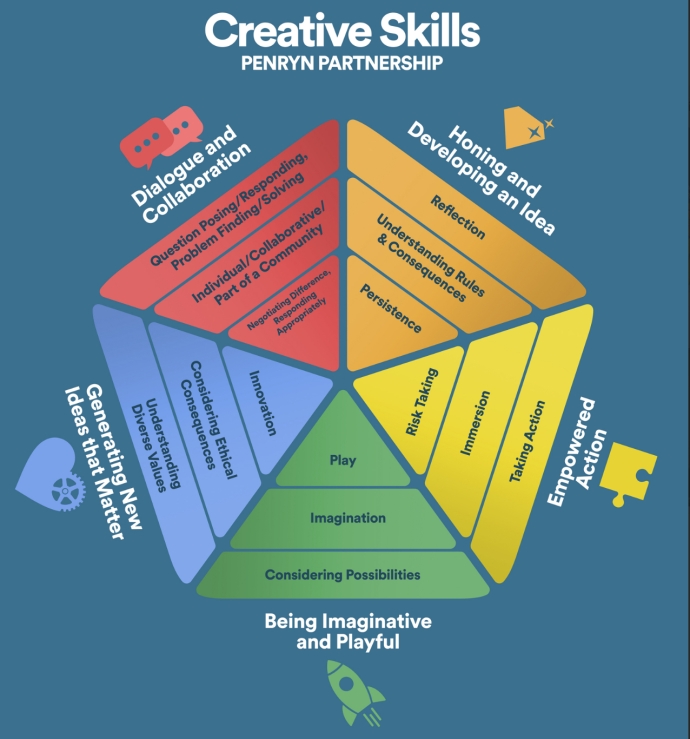
In year one (2021-22) of the Penryn Creativity Collaborative, we set out to question, challenge and explore, working towards creating a model of creative skills and pedagogies. Through explorative research across our learning community, we explored three questions:
- Why are creative skills needed in a changing workforce?
- What creative skills are needed to be developed by Cornish students to become better prepared?
- How do we best prepare teachers for teaching for creativity?
From spring 2022, working alongside the expertise of Associate Professor Kerry Chappell and Ursula Crickmay from the University of Exeter, we leapt into a range of explorative research methods: a literature review; a business and cultural partners survey; a range of focus groups; and interviews to explore approaches to teaching and learning across the Penryn Partnership.
Year two
In year two (2022/23), we felt better equipped to understand why creative skills are needed and what creative skills are needed to become more prepared for a changing workforce for our Cornish students. Our focus was on building and testing. We wanted to develop a model for developing pedagogy across a partnership of schools and to develop leaders and teachers who are promoting and implementing change for the teaching of creativity. Thirteen teachers across the Penryn Partnership were inspired to participate in action research during the 2022/23 school year. Across our learning community, each action research coach explored their own research question linked to our emerging language around creative skills and pedagogy.
Our action research programme promoted professional collaboration and helped to establish a team of staff as an evidence-based group. Our teachers worked and learned with the expertise of the team from the University of Exeter, as well as with industry and cultural partners in their classrooms, allowing them to hold firm to our overarching question about how we prepare young people for a changing workforce.
Year three
Our ambition in year three (2023/24) was to embed and grow, extending the scope of our project and ensuring long-term systemic change and impact across the Penryn Partnership and beyond. Across the partnership, a learning community of leaders and teachers cascaded practice from their work so far to extend the impact of teaching for creativity. Our year one to three report shares the impact on our schools from the Creativity Collaboratives pilot phase.
-
Legacy phase
Through the Legacy Phase (2024-26), the Penryn Creativity Collaborative aims to:
consolidate learning from the pilot phase, exploring how we have developed teaching for creativity in our schools, so that others can learn from our journey
embed and deepen practice across the Penryn Partnership, demonstrating how teaching for creativity has found its place in our schools using the Penryn Creativity Collaboratives model of creative skills and pedagogies
increase evidence on the impact on pupils, including how teaching for creativity fosters an equitable curriculum
create a sustainable programme of working with stakeholders (industry, cultural partners, parents) to ensure we continue to ‘better prepare’ young people for a modern workforce
grow our Penryn Creativity Collaborative toolkit of well-tested resources to support sustainability beyond legacy (How do we embed and deepen teaching for creativity in our schools – a model to share)
We want to:
develop the Penryn Creativity Collaborative frameworks for schools to use for self-assessment, development and reflection
develop the Penryn Creativity Collaborative toolkit, including teaching approaches, tools and resources tested by schools
continue our partnership with the University of Exeter, working with Professor Kerry Chappell and Ursula Crickmay as they develop a ‘train the trainer’ programme and resources for action research, and for leaders to flourish in developing practice in teaching for creativity. We hope that by the University of Exeter sharing an approach to action research, we can cultivate others to develop an ambitious curriculum with teaching for creativity throughout